Search


Last updated: September 10, 2026
China has a deep and highly diversified supply base for lithium iron phosphate cells. The challenge for an energy storage buyer is finding a manufacturer whose cell format, capacity range, quality controls and commercial model fit the project. A large utility-scale integrator may prioritize high-capacity prismatic cells and bankability. A pack developer may need cylindrical cells, flexible order quantities, engineering support and a responsive supply relationship.
This guide compares ten established or specialized LiFePO4 cell manufacturers serving energy storage applications. It summarizes their publicly presented product focus and explains where each supplier may fit in a sourcing strategy. The list includes large-scale cell groups and a specialist cylindrical cell manufacturer so buyers can compare different supply models within one practical framework.
The order is an editorial sourcing shortlist based on public product information and likely purchasing fit. It is not a market-share, shipment-volume or financial ranking. Product specifications, certifications, production status and regional availability can change. Buyers should verify the current model-level datasheet, test reports and commercial terms before placing an order.
For buyers comparing lithium cell manufacturers or searching for li ion cell manufacturers, the most useful first step is to match cell architecture and supplier capability to the intended system. The table below provides a quick view of each manufacturer’s public focus. Detailed profiles and a project-fit framework follow.
Manufacturer | Representative public focus | Cell format or range | Potential best-fit applications | Buyer’s verification point |
CATL | Large-scale stationary storage cells and complete systems | High-capacity prismatic LFP | Utility-scale and large commercial storage | Confirm model availability, integration route and project-specific warranty |
EVE Energy | Cells and solutions for grid, telecom and household storage | Prismatic LFP portfolio | Grid ESS, telecom backup and residential ESS | Match certifications and cycle-life conditions to the selected model |
HiTHIUM | Stationary storage and long-duration energy storage | 314Ah, 587Ah and larger LFP cells | Utility-scale and long-duration projects | Verify regional supply, qualification status and current production model |
Gotion High-Tech | Cell-to-system energy storage portfolio | Prismatic lithium cells and integrated systems | Peak shaving, reserve power and load management | Request a project-specific cell and system specification package |
REPT BATTERO | Utility and residential energy storage cells | About 50Ah to 588Ah across published ranges | Residential, C&I and utility storage | Confirm the exact certification matrix for the target market |
CALB | High-capacity storage cells and containerized systems | Prismatic LFP, including a published 392Ah platform | Large C&I and utility-scale storage | Ask for the latest datasheet and mass-production delivery schedule |
Great Power | Large-capacity cells and storage systems | Prismatic LFP, including a published 587Ah cell | Utility and large commercial storage | Check test conditions behind efficiency and cycle-life claims |
CORNEX | Cells for home, C&I, telecom and grid storage | Published 100Ah, 314Ah and 588Ah LFP models | Multi-scenario stationary storage | Validate model-level safety tests and certification scope |
Lishen Battery | Energy storage cells and system integration | Prismatic LFP, including a published 280Ah model | Power, C&I and household storage | Request current reports, warranty terms and after-sales coverage |
Lyrasom | Full-tab cylindrical LFP cells and custom battery packs | 32140 15Ah and 40140 20Ah | Modular ESS, telecom, solar, backup power and light mobility | Align cell matching, pack design and target-market certification at RFQ stage |
A useful supplier comparison needs to go beyond company size. The evaluation framework below focuses on publicly verifiable information and the questions that influence real purchasing decisions.
We reviewed whether each manufacturer presents a clear energy storage portfolio and which applications it addresses. High-capacity prismatic cells are common in utility-scale containers because they support efficient system packaging and reduce the number of cell connections. Cylindrical LFP cells can be valuable when the project needs modular pack architecture, mechanical robustness, thermal pathways or a format shared across stationary storage and mobility products.
Capacity alone does not determine suitability. Charge and discharge rate, usable state-of-charge window, temperature range, expected dwell time, cooling method, pack voltage and service profile all affect cell selection. Every shortlisted model should therefore be checked against the actual duty cycle.
We prioritized manufacturers that publish identifiable products, application information or certification references. Certification must be checked at model level. A company-wide certificate or a test completed on another product does not automatically cover the cell, module or battery system being purchased. Buyers should ask for current reports from recognized laboratories and confirm the standard, model number, applicant, validity and target market.
Important evidence may include UN38.3 transport testing, IEC 62619 industrial battery safety, UL 1973 stationary battery requirements and UL 9540A thermal-runaway propagation testing. The required combination depends on product architecture, destination and local approval pathway.
Cell consistency has a direct impact on pack balancing, usable capacity and long-term maintenance. Procurement teams should examine incoming material control, electrode and assembly process control, cell grading, capacity testing, internal-resistance distribution, traceability and aging procedures. For custom packs, the review should also cover welding, BMS integration, insulation, end-of-line testing and communication checks.
Commercial fit matters as much as technical fit. Some leading manufacturers primarily serve major integrators through large-volume programs. Specialist suppliers may offer quicker technical communication, cylindrical formats, pack engineering and more adaptable order quantities. A strong shortlist should reflect the buyer’s annual volume, development stage and qualification resources.
CATL is a major global battery producer with a broad presence in electric mobility and stationary energy storage. Its energy storage portfolio is oriented toward large projects, where cell design, container architecture, thermal management and system-level safety need to work together. The company’s TENER platform is presented as a 6.25MWh-class storage system using LFP chemistry, illustrating its focus on high-energy-density utility applications.
CATL is a logical candidate for bankable, high-volume projects that require a globally recognized supplier and integrated system options. Access may depend on project scale, approved commercial channels and delivery region. Buyers should request the exact cell or system model, degradation assumptions, warranted throughput, auxiliary consumption, thermal-management design and local service commitments. Published platform claims should be evaluated under the proposed operating conditions rather than transferred directly to a different configuration.
Official reference: CATL TENER energy storage platform.
EVE Energy supplies prismatic LFP cells and energy storage solutions for grid, telecom and household applications. Its public product information emphasizes automated manufacturing, safety, low internal resistance, long service life and configuration flexibility. This breadth makes EVE relevant to integrators building multiple product lines or serving several stationary storage segments.
Procurement teams should identify the exact cell family before comparing quotations. Grid-storage cells, telecom modules and residential products may use different qualification packages, cycle-life assumptions and supply terms. Ask EVE or its authorized channel to document nominal capacity, energy, dimensions, terminal design, recommended compression, charge and discharge limits, storage conditions and certification coverage. Integrators should also confirm whether commercial support includes cell samples, application engineering, failure analysis and long-term continuity for the selected model.
Official references: EVE prismatic LFP cells and EVE energy storage applications.
HiTHIUM concentrates on stationary energy storage and has developed a portfolio spanning common utility-scale capacities and larger cells for long-duration systems. Its current public range includes 314Ah and 587Ah LFP cells as well as higher-capacity platforms. The company publishes cycle-life and certification information for individual products, which gives engineering teams a useful starting point for qualification.
This supplier is especially relevant to container manufacturers and project developers seeking cells designed around storage duty cycles. Larger-capacity cells can reduce connection count and simplify some aspects of system assembly, although they also place greater importance on thermal uniformity, mechanical restraint, service strategy and supplier continuity. Buyers should verify which model is in sustained mass production, available in the target region and supported by the required reports. Cycle-life comparisons should use aligned temperature, depth-of-discharge, charge rate, discharge rate and end-of-life criteria.
Official reference: HiTHIUM energy storage cell portfolio.
Gotion High-Tech offers battery chemistry, cells, battery management, modules, packs and energy storage systems. Its public portfolio covers use cases such as peak shaving, backup power and load management. This vertical range can suit customers who want to discuss cell supply alongside a wider module or system roadmap.
Gotion may be a practical shortlist candidate for utility and commercial projects where an integrated solution or a large manufacturer’s engineering resources are valuable. Public overview pages provide broad positioning, so serious buyers should obtain project-specific technical documentation. The RFQ should identify the proposed cell model, usable capacity target, duty cycle, cooling approach, container configuration, communication protocol and destination-country requirements. Clarify whether the quotation covers cells, modules, racks or a complete system, since warranties, commissioning duties and interface ownership change substantially between those supply scopes.
Official reference: Gotion product and energy storage overview.
REPT BATTERO publishes an extensive LFP cell range for stationary storage. Its utility-focused portfolio includes capacities from 280Ah to 588Ah, while its residential range includes smaller cells around 50Ah to 100Ah. This breadth lets buyers examine one supplier across residential, commercial and utility product families.
The company is relevant when an integrator values high-capacity prismatic options and a visible roadmap across storage segments. Its product pages present model-level information such as chemistry, nominal capacity, cycle-life figures and certification references. These data points should be validated in the latest controlled datasheet and test reports. Ask whether cycle testing used constant compression, what end-of-life threshold was applied, how internal resistance is measured and which models are commercially available. Buyers planning multiple pack designs should also confirm whether cells from different capacity families share terminal, compression or manufacturing-control conventions.
Official reference: REPT BATTERO energy storage cells.
CALB has long experience in prismatic lithium cells and presents solutions for energy storage alongside transportation applications. Recent company announcements highlight the ZHIJIU energy storage cell series and a 392Ah storage cell paired with a 6.25MWh liquid-cooled container platform. These releases show a clear direction toward higher-capacity cells and large stationary systems.
CALB may fit established integrators and developers that need prismatic cells from a scaled producer. Product-launch information is useful for identifying the roadmap, while procurement decisions require released production specifications. Ask for the latest revision-controlled datasheet, PPAP or equivalent quality documentation where applicable, safety reports, cycle-test curves and lead-time commitments. The buyer should also confirm whether the proposed cell is in sample, pilot or full mass-production status. For container projects, clarify who owns module design, compression, cooling interfaces and system certification.
Official references: CALB ZHIJIU series announcement and CALB 392Ah cell and 6.25MWh system announcement.
Great Power supplies energy storage cells, packs and systems for applications ranging from residential products to utility projects. In 2026, the company presented a 587Ah LFP cell and a 6.25MWh container solution for utility-scale storage. Its published information emphasizes long cycle life, energy efficiency and manufacturing inspection controls.
This product direction makes Great Power relevant to developers and system integrators evaluating newer high-capacity formats. Comparisons require consistent test boundaries. A cycle-life value should be read together with temperature, depth of discharge, C-rate, rest periods, compression and capacity-retention threshold. The same principle applies to round-trip or cell energy efficiency. Buyers should request raw or summarized validation curves, manufacturing traceability procedures, approved cell-to-pack guidance and warranty exclusions. Commercial review should cover forecast flexibility, production allocation, delivery terms and the response process for field-quality issues.
Official reference: Great Power 587Ah cell and storage system.
CORNEX offers an energy storage portfolio covering power generation, grid applications, commercial and industrial systems, household storage and telecom backup. Its public cell lineup includes 100Ah, 314Ah and 588Ah LFP models, giving integrators options for several system sizes and packaging strategies.
CORNEX deserves consideration when a buyer wants access to both mainstream and larger-capacity prismatic formats. Its product pages list cycle-life and certification references, which should be used to build a document request rather than treated as the final approval package. Confirm the specific certificate and test-report model numbers, date of issue, sample configuration and market applicability. Engineering teams should also review swelling behavior, recommended compression, heat generation, state-of-charge calibration and cell consistency limits. These details affect module structure, cooling design and long-term balancing performance.
Official reference: CORNEX energy storage solutions and cells.
Lishen Battery presents energy storage cells and one-stop system integration for power, commercial and industrial, and household markets. The company has worked in energy storage since 2010 and publishes safety certification references across its portfolio. Its current public information includes a 280Ah, 0.5P prismatic storage cell.
Lishen can fit buyers seeking a long-established Chinese lithium cell manufacturer with both cell and system capabilities. The 280Ah class remains familiar to many integrators, which may help with existing module designs and qualification experience. Buyers should still confirm the current generation, dimensional tolerances, terminal design, recommended clamping force, cycle-test protocol and delivery continuity. If the project sources only cells, establish clear responsibility for pack engineering and certification. If it sources a larger system, define commissioning, software interfaces, spare parts and local service in the contract.
Official references: Lishen energy storage overview and Lishen 280Ah energy storage cell.
Lyrasom is a specialist manufacturer of lithium-ion and sodium-ion cells and battery packs. Its LFP range centers on full-tab cylindrical formats, including 32140 3.2V 15Ah LFP cells and 40140 3.2V 20Ah LFP cells. This format focus gives pack developers an alternative to the large prismatic cells that dominate utility-scale containers.
The published 40140 specification lists 20Ah nominal capacity, internal resistance of no more than 3mΩ, a maximum continuous discharge rate of 2C and a 5C pulse rating for 10 seconds. It also lists a cell weight of 400g, gravimetric energy density of 160Wh/kg, a 0°C to 55°C charging range and a -20°C to 60°C discharge range. Engineering teams should confirm the latest datasheet and qualify performance in their own pack design.
Lyrasom reports 4GWh of annual production capacity and a 34,000m² factory. The company supplies cells as well as custom battery packs, which can shorten the communication path between cell selection, BMS integration, welding and pack validation. Its documented quality-control process includes cell voltage and resistance distribution checks, laser welding, weld inspection, BMS connection, PC testing, aging, communication testing, finished-product testing, insulation and packing.
Lyrasom is especially relevant to modular stationary storage, telecom backup, solar storage, portable or distributed systems and products that benefit from cylindrical construction. Buyers can review the complete LFP and sodium-ion cell portfolio and discuss matching, pack layout and target-market requirements with the engineering team.
The right supplier depends on the system architecture, commercial scale and certification route. A useful decision begins with the product being built, then works backward to the cell and supplier requirements.
For grid containers and long-duration systems, CATL, HiTHIUM, REPT BATTERO, CALB, Great Power and CORNEX offer visible high-capacity prismatic portfolios. The buyer’s engineering review should focus on thermal uniformity, compression, propagation testing, expected throughput and the interaction between cell warranty and system operating strategy. Project developers should also examine bankability, local service and long-term production continuity.
EVE, Gotion, CORNEX, Lishen and Lyrasom address applications that can include commercial storage or backup power. The preferred format depends on enclosure size, cooling, discharge demand and maintenance strategy. A supplier able to support both cells and pack engineering may be valuable for a new platform or a highly customized enclosure. A large standardized system may benefit from an established prismatic module ecosystem.
Residential and distributed products need careful attention to installation environment, acoustic limits, usable energy, inverter communication and regional certification. EVE and REPT BATTERO publish cell or solution families relevant to household storage. Lyrasom’s 32140 and 40140 cylindrical cells suit developers building modular packs or sharing a cell platform across stationary and light-mobility products. Final selection should follow electrical, thermal and mechanical validation in the intended module.
Project profile | Prioritize | Typical supplier direction |
Large utility container | High-capacity cells, throughput warranty, propagation evidence, bankability | Scaled prismatic LFP manufacturer with system-level experience |
C&I cabinet | Packaging efficiency, thermal control, serviceability and certification | Prismatic cell or integrated-system supplier |
Telecom or backup pack | Float behavior, standby life, communication and enclosure fit | Supplier with telecom references and pack support |
Modular cylindrical pack | Cell matching, welding, thermal pathways and flexible configuration | Specialist cylindrical LFP cell and pack manufacturer |
New or customized product | Engineering response, samples, validation support and manageable MOQ | Supplier with a clear OEM/ODM development process |
A detailed RFQ helps a lithium cell supplier recommend an appropriate model and reduces the risk of comparing quotations built on different assumptions. Send the same core requirements to every shortlisted supplier.
RFQ item | Information to provide or request | Why it matters |
Application and duty cycle | ESS type, daily cycles, dwell time, peak load and expected service life | Determines the appropriate cell design and warranty assumptions |
Electrical requirements | Nominal energy, system voltage, continuous and peak current, charge rate and usable SOC window | Defines cell count, parallel groups and stress profile |
Operating environment | Charging and discharge temperatures, altitude, humidity, ingress risk and installation location | Affects thermal design, derating and enclosure requirements |
Mechanical constraints | Cell format, pack envelope, weight limit, orientation, cooling method and service access | Prevents selection of a cell that cannot be integrated safely |
Cell consistency | Capacity, voltage and internal-resistance sorting limits; grading method; traceability | Supports pack balance, usable energy and repeatable production |
Technical evidence | Controlled datasheet, cycle curves, rate performance, storage data and safety test results | Allows engineering comparison under consistent conditions |
Compliance | Destination market, required standards, model-level certificates and transport documents | Reduces approval, shipping and customs risk |
Commercial scope | Sample quantity, MOQ, annual forecast, target price basis, Incoterm, lead time and payment terms | Makes supplier quotations directly comparable |
Quality agreement | Change notification, incoming acceptance limits, lot traceability, defect handling and audit rights | Protects consistency after qualification |
Pack support | Busbar or welding guidance, BMS, thermal design, enclosure, prototyping and validation responsibilities | Clarifies interfaces and shortens development time |
Before approving a supplier, test production-representative samples from identified lots. Record capacity, DC internal resistance, open-circuit voltage, self-discharge, temperature rise and cell-to-cell distribution. Pilot packs should then be validated at the maximum expected electrical and environmental conditions. The approved specification, golden sample, inspection method and engineering-change process should become part of the purchase agreement.
Need 32140 or 40140 LiFePO4 cells for an energy storage or mobility project? Send Lyrasom your target capacity, voltage, discharge rate, certification market, annual volume and pack requirements. Our team will review cell compatibility and provide the relevant specifications.
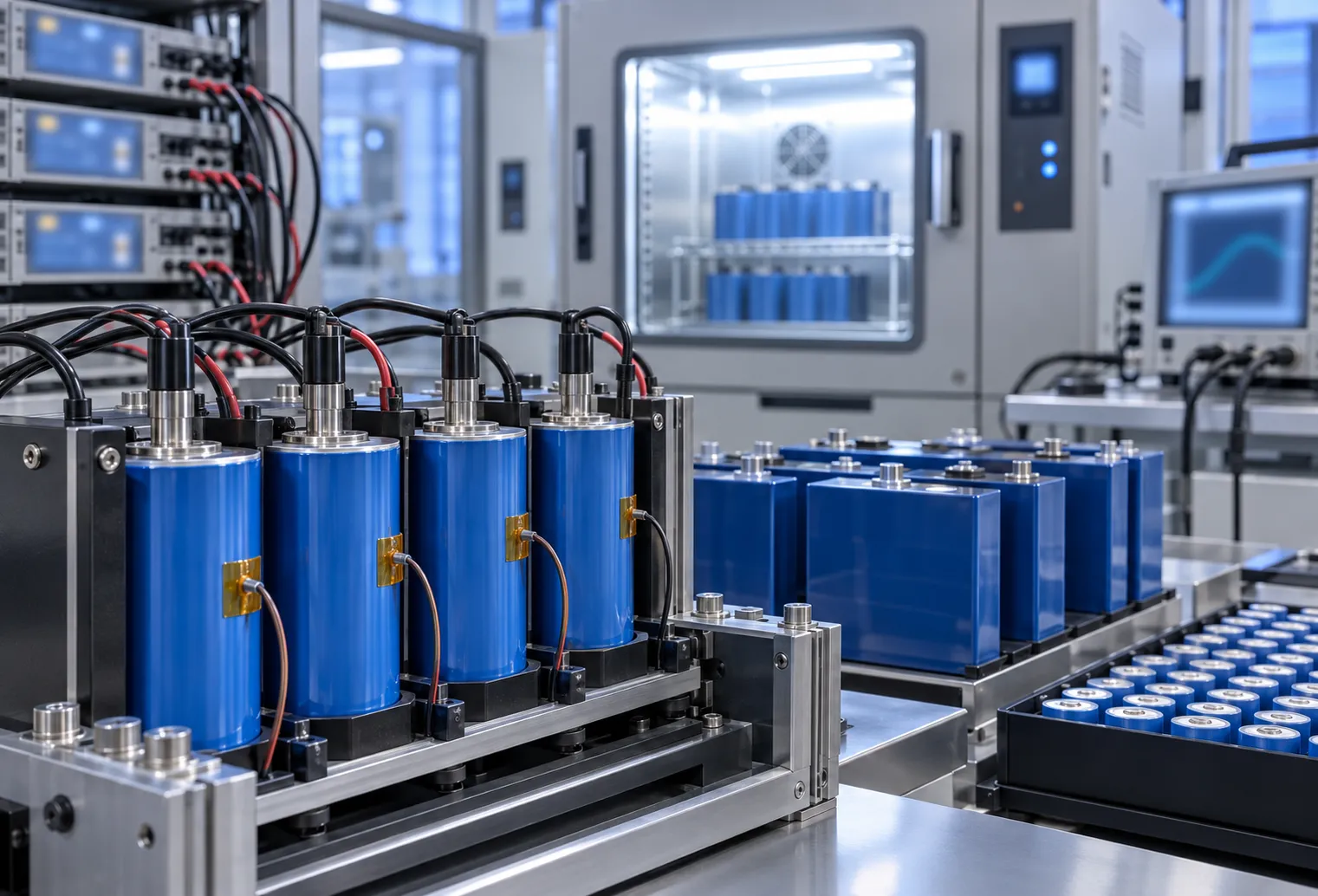
China’s supply base includes CATL, EVE Energy, HiTHIUM, Gotion High-Tech, REPT BATTERO, CALB, Great Power, CORNEX, Lishen Battery and specialist manufacturers such as Lyrasom. The most suitable choice depends on cell format, project scale, target market, qualification evidence and required engineering support. A supplier’s shipment volume alone cannot establish fit for a specific battery system.
Compare the exact cell model, format, dimensions, energy, internal resistance, charge and discharge limits, temperature range and cycle-test conditions. Then review cell consistency, manufacturing traceability, change control, safety reports, model-level certifications, lead time, warranty and after-sales response. Use the same duty cycle and commercial assumptions for every quotation.
Both formats can work well when correctly engineered. Large prismatic cells can reduce connection count and support high packaging efficiency in standardized storage containers. Cylindrical cells can support modular architecture, repeatable mechanical construction and flexible pack shapes. The decision should consider cooling, joining method, serviceability, fault containment, production equipment and total system cost.
32140 LFP cells and 40140 LFP cells are large cylindrical formats used in modular energy storage, solar batteries, telecom backup, portable power and light electric mobility. Buyers evaluating 32140 cells usually compare capacity, resistance, rate capability and matching limits. A 40140 battery pack also requires qualified welding, BMS and thermal design. Lyrasom offers a 32140 15Ah cell and a 40140 20Ah cell.
The required documents vary by destination and system design. Common references include UN38.3 for transport, IEC 62619 for industrial lithium batteries, UL 1973 for stationary battery applications and UL 9540A test data for thermal-runaway propagation assessment. Buyers should verify that each report covers the exact model and configuration being purchased and confirm requirements with the relevant certification body or local authority.
Start with a detailed RFQ and qualify the exact production model. Audit the manufacturing and testing process, review model-level reports, test traceable samples and build a pilot pack. Agree on acceptance limits for capacity, voltage and internal resistance. Put change notification, warranty handling, lot traceability and failure-analysis responsibilities into the supply agreement.

 English